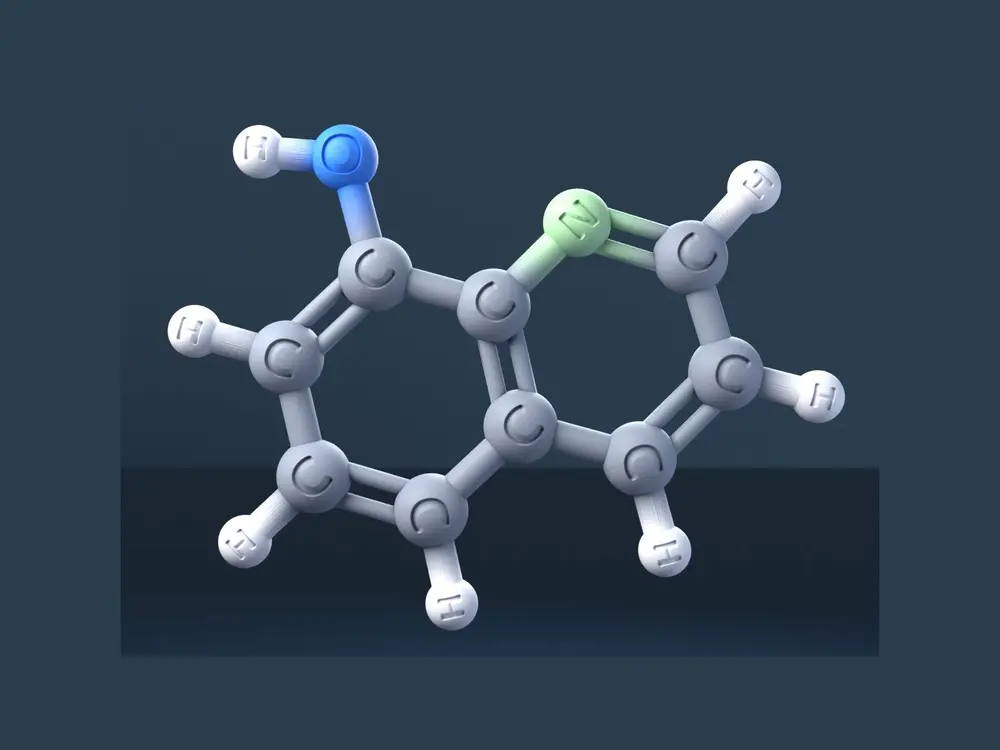
8-Hydroxyquinoline Molecule 3D Model with Engraved Atoms - Chemistry Teaching Aid (CAS 148-24-3)


8-Hydroxyquinoline molecular model (C9H7NO, CAS 148-24-3): a free, print-ready ball-and-stick model with the element symbol engraved on every atom, designed for chemistry lessons.
Let the group sketch what they see in 8-Hydroxyquinoline, namely two 6-membered rings, fused along a shared edge, both aromatic; afterwards they compare the sketch with the 19 bonds on the model (8 single and 11 aromatic, drawn in Kekulé form). Hand the model round and let students tally the engraved atoms: 9 C + 7 H + 1 N + 1 O, 18 in total. Spot-the-group challenge: can students find the phenolic hydroxyl group (Ar-OH) and the pyridine-type ring nitrogen? Worth bringing out when the syllabus reaches aromaticity and delocalised electrons, fused ring systems, heteroaromatic rings (nitrogen inside an aromatic ring), as well as phenols and hydrogen bonding. Place it beside 2,2':6',2''-Terpyridine (CAS 1148-79-4) and 6-Aminoquinoline (CAS 580-15-4) and ask students which features are shared and which are not.
Printing: the STL is in angstrom units - scale it 10x in the slicer (1 angstrom = 10 mm). Use supports under the bonds; PLA works well.
Full data, safety notes and other formats: https://molgod.org/molecule/148-24-3/
Licence and provenance: https://molgod.org/licenses/stl/148-24-3/
MolGod ID: MG_259-537-449-58
Also published on: NIH 3D https://3d.nih.gov/entries/3DPX-023720 · Zenodo (DOI, latest version) https://doi.org/10.5281/zenodo.23277295 · Figshare (dataset DOI) https://doi.org/10.6084/m9.figshare.34425396
Atomic coordinates: PubChem computed 3D conformer; mesh generated by MolGod's own software. Licence: CC BY-SA 4.0, MolGod.org.