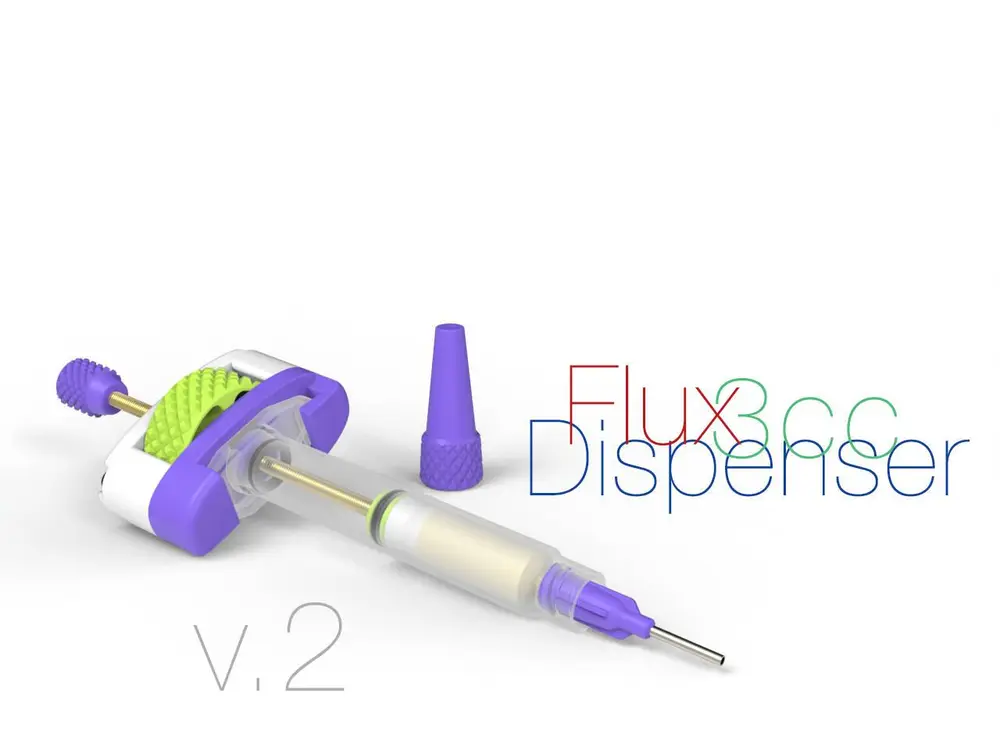
Flux Dispenser 3cc v.2


Flux Dispenser 3cc v.2
A fresh take on an old idea
When I made new nozzles for lubricating the printer, it instantly clicked — it was time to update the dispenser itself. To be honest, the previous version worked well enough, but I had a few goals in mind: improve the ergonomics, eliminate unnecessary post-processing, and… just see what my printer is really capable of at full throttle.
That’s how the Flux Dispenser v.2 was born — a simple yet precise tool that’s genuinely satisfying to use.
What’s changed?
At first glance — almost nothing. But that’s misleading. The real improvements are in the details. I completely reworked the design from the perspective of ease of use and print precision. For example, I managed to print fully functional M2.5 and M3 threads directly on the printer, no post-processing needed. Who would’ve thought M2.5 could be printed at all? Of course, this required a finer nozzle and thinner layers. Yes, printing takes longer now, but the result speaks for itself — parts come together without any filing.


Design and Materials
This time I printed the body and the plunger in PLA, and the feed wheel in ABS. Visually, the use of complementary colors creates a contrast I personally really like. But of course, you can go with your own color scheme. The entire design still prints fine even with a standard 0.4 mm nozzle — the only exception might be the threads, which could require a bit of cleanup with a tap.
What’s with the ring?
Great question. A lot of people ask why there’s an O-ring on the secondary plunger — the one with small holes and no sealing function. Simple: it prevents the shaft from spinning. When you turn the feed wheel, the threaded rod pushes the plunger forward or pulls it back, and the ring keeps it from rotating. It’s a small detail — but it adds a lot of stability.
Why 3 ml?
Because it’s convenient. I load the grease into the syringe once — and that amount is just right for a full printer maintenance cycle. The same 3 ml size works for soldering too — flux, solder paste, whatever. Small volume, precise delivery, nothing dries out or hardens. Minimalism at its best.
By the way, in the description you’ll find links to my other designs — Luer lock nozzles for lubricating leadscrews and shafts, syringe-to-syringe adapters for transferring grease, and other useful accessories. And yes, even the cap — it’s new too.
Video & Assembly
This project is as simple as it gets. A few parts, a few screws — and you’re done. Watch the assembly video for a full walkthrough. In the meantime — print it, build it, experiment.Flux Dispenser v.2 is ready to go.
See the video for details:

If you liked this thing - let me know by putting like!
Parts links below:
- ESUN Filament PLA
- eSUN eABS+HS
- Industrial Syringe 3CC
- Axial Thrust Ball Bearing F3-8M
- Threaded Rod Brass M3
- Threaded Rod M3
- Button Head Screw M2.5
- Heat Insert Nut Iron Tip
- Insert Knurled Nuts M3
- Black O Ring Gasket CS 2mm OD 9mm
- Steel Dispensing Needles Tips
- Luer Lock Adapter Coupler
- Round Magnet 3x3 mm
Links to used tools:
- NOGA deburring tool and Blades
- Angle grinder
- Reamer Tool Set
- Carbide Machine Reamer
- Reamers Small
- Thread Screw Tap
- Tap Drill Bit
My new machine:


My favorites:

Thank you for every tip or donation,
it means great recognition for me and helps a lot to keep going!

BTC:bc1qplpzq36ghw84hty4nn2zzu4ps4sdh4th0v93j8
ETH:0xc766ebbeAa76aaf629788c8F99C33A8d80d48977
My some other things: