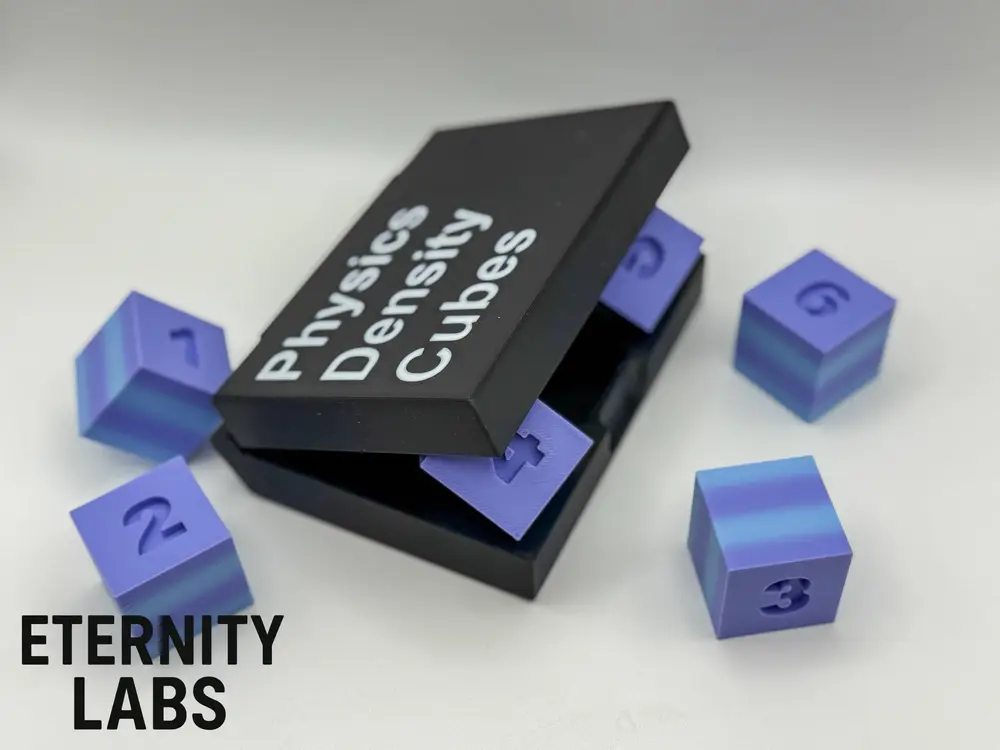
Physics - Density Cubes


Density Cubes Classroom Set
Bring hands-on physics into the classroom with this set of six density cubes and a compact storage case.
Each cube has the same external volume but a different mass. This allows students to investigate how objects of identical size can have different densities. The set is designed as a simple, reusable teaching aid that makes density easier to understand through practical experimentation.
Cube Masses
- Cube 1: 6.9 g
- Cube 2: 10.7 g
- Cube 3: 15.4 g
- Cube 4: 20.4 g
- Cube 5: 24.8 g
- Cube 6: 30.4 g
Printed masses may vary slightly depending on filament, printer calibration, infill, material density and slicer settings.
How to Use the Cubes
Method 1: Measure and Compare Mass
Ask students to weigh each cube using a digital scale or laboratory balance.
Because every cube has the same volume, students can compare their masses directly. The heavier cubes have a greater density, while the lighter cubes have a lower density.
Students can calculate density using:
Density = Mass ÷ Volume
This activity can be used to introduce density calculations, data tables, graphing and comparisons between objects.
Method 2: Eureka Can Water Displacement
The volume of each cube can be measured using a Eureka can.
- Place the Eureka can on a level surface.
- Fill it with water until water begins to flow from the spout.
- Allow the excess water to drain until the dripping stops.
- Place an empty measuring cylinder beneath the spout.
- Carefully lower one cube into the water until it is completely submerged.
- Collect the displaced water in the measuring cylinder.
- Read the volume of the collected water.
- The volume of displaced water is equal to the volume of the submerged cube.
- Divide the cube’s measured mass by its volume to calculate its density.
Density = Mass ÷ Volume
Repeat the experiment with each cube and compare the results.
As all six cubes have the same external volume, they should displace approximately the same amount of water. However, their calculated densities will be different because each cube has a different mass.
Ensure that the cube is fully submerged and that trapped air bubbles are removed before taking the measurement. A thin thread may be used to lower the cube into the Eureka can.
Classroom Activity Ideas
Students can:
- Arrange the cubes from lowest to highest mass.
- Predict which cube has the greatest density.
- Measure and record the mass of each cube.
- Use a Eureka can to measure the cube volume.
- Calculate the density of each cube.
- Compare results between different groups.
- Plot mass against density.
- Discuss why objects of the same size can have different masses.
- Identify possible sources of experimental error.
The included case keeps the full set organised between lessons and makes the cubes easy to store or transport.
This model is a great example of how 3D printing can be used to create affordable, practical and engaging classroom equipment. It is ideal for physics lessons, STEM activities, science demonstrations, homeschooling and introductory laboratory work.
您不得分享、转授权、出售、出租、托管、转让或分发该数字文件或该对象的3D打印版本,以及以数字或物理形式存在的任何其他衍生作品(包括混音)。未经许可,您不得以任何方式使用这些物品进行费用收取。