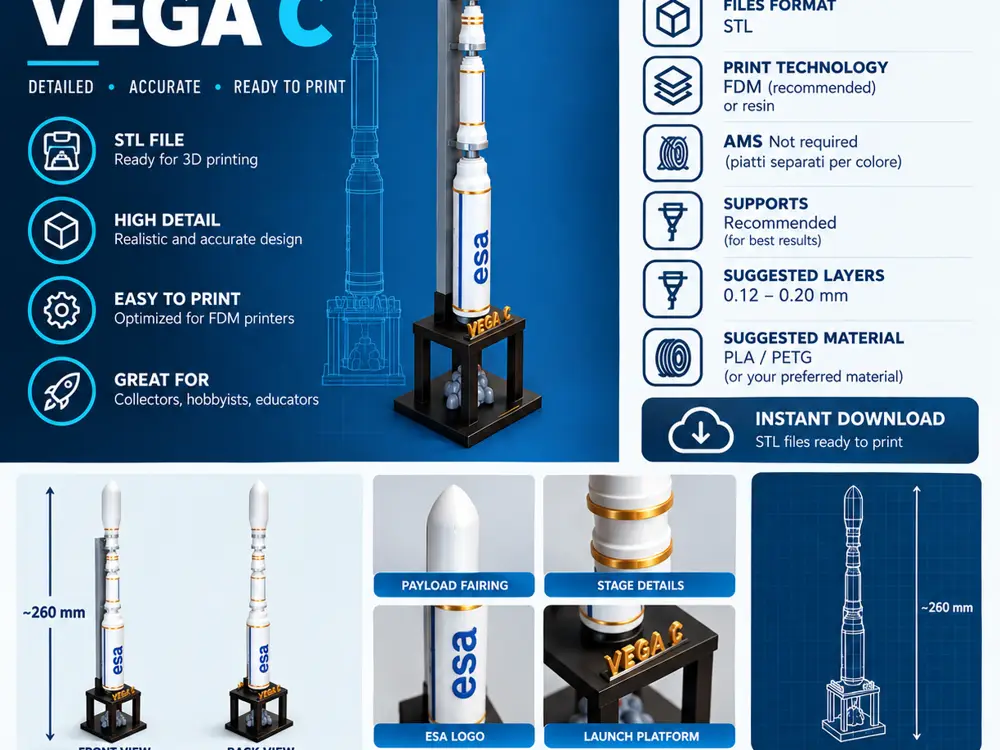
Vega C Rocket Model - 1:144


VEGA-C 1:144
From a static model to a piece of engineering you can explore.
The Vega-C was not designed to be just another static display model.
This project was born from a simple idea: turn a scale model into a small mechanical and educational system, allowing the structure of the launcher to be explored and displayed.
Every component was designed from scratch in OpenSCAD, with particular attention to modularity, tolerances, assembly, and FDM printability.
🚀A Vega-C you can actually take apart
The model reproduces the Vega-C in 1:144 scale, including its four stages:
P120C · Zefiro 40 · Zefiro 9 · AVUM+
The stages are not simply stacked together - they screw together.
This allows the rocket to be displayed fully assembled or separated into its individual stages, revealing details that would normally remain hidden.
The real stars are the engines.
When the rocket is disassembled, the different motor nozzles become clearly visible, turning the model into an exploded representation of the launcher.
🔧Two models in one
CONFIGURATION 01 - ROCKET
Fully assembled, the model becomes a compact Vega-C display model, approximately 250 mm tall.
Clean, recognizable and ready for the shelf.
CONFIGURATION 02 - ENGINEERING DISPLAY
Using the dedicated display stand, the stages are separated and suspended one above another.
Threads, connections and nozzles become visible.
The result is no longer just a model of the Vega-C:
it is a model that shows how the Vega-C is built.
🧩 Designed, not simply split
One of the main goals was to avoid simply taking a model and cutting it into printable pieces.
Every component was designed with real FDM manufacturing constraints in mind.
The parts were optimized for:
- 0.4 mm nozzle FDM printing;
- mechanical assembly;
- controlled tolerances;
- printable threads;
- separate color inserts;
- repeated assembly and disassembly;
- exploded-display configuration.
🎨Multicolor - with or without AMS
The model is designed to work both with an AMS-equipped printer and with a standard FDM printer without automatic filament switching.
Color details are separated into individual components and organized into dedicated print plates.
🎨 Six colors
WHITE - stage bodies and fairing
BLACK - base and nozzles
GRAY - display stand, arms and cloud
BLUE - lines and ESA lettering
GOLD - stage bands and details
RED - flame
With AMS, the plates can be printed using the required colors.
Without AMS, each color can simply be printed separately and assembled afterwards.
No mid-layer filament changes are required.
💻Built in OpenSCAD
The entire project was developed in OpenSCAD.
The geometry is generated parametrically from the component profiles and scaled to 1:144.
Even the smallest details were designed with actual printability in mind.
🛰️A small model with a big idea
Vega-C represents Europe's access to space.
I wanted to turn that idea into a model that was not only visually accurate, but also allowed the user to look inside the rocket and understand its architecture.
The exploded configuration makes the four-stage sequence immediately visible and allows the different propulsion systems to be compared.
It is a model to build, take apart, explore and assemble again.
📐SPECIFICATIONS
Model: Vega-C
Scale: 1:144
Assembled height: ~250 mm
Stages: 4
Propulsion: P120C · Z40 · Z9 · AVUM+
Software: OpenSCAD
Printing: FDM
Nozzle: 0.4 mm
Supports: ❌ Not required
AMS: ✅ Optional
Assembly: Screw-fit + inserts
Display stand: ✅ Included
🏆ROCKET REVOLUTION
This project combines three passions:
space · scale modeling · parametric design
The result is a Vega-C that doesn't just try to look like a rocket.
It allows the person who prints it to explore how the rocket is structured.
🚀 Build it.
🔧 Take it apart.
🛰️ Understand it.
-----------------------
VEGA-C 1:144
Da un modello statico a un oggetto di ingegneria da esplorare.
Il Vega-C non è stato progettato per essere semplicemente un altro modello statico da esposizione.
Questo progetto nasce da un'idea semplice: trasformare un modello in scala in un piccolo sistema meccanico e didattico, che permetta di esplorare e mostrare la struttura del lanciatore.
Ogni componente è stato progettato da zero in OpenSCAD, con particolare attenzione a modularità, tolleranze, assemblaggio e stampabilità FDM.
🚀Un Vega-C che puoi davvero smontare
Il modello riproduce il Vega-C in scala 1:144, compresi i suoi quattro stadi:
P120C · Zefiro 40 · Zefiro 9 · AVUM+
Gli stadi non sono semplicemente impilati l'uno sull'altro: si avvitano tra loro.
Questo permette di esporre il razzo completamente assemblato oppure di separarlo nei singoli stadi, rivelando dettagli che normalmente rimarrebbero nascosti.
I veri protagonisti sono i propulsori.
Quando il razzo viene smontato, i diversi ugelli dei motori diventano chiaramente visibili, trasformando il modello in una rappresentazione esplosa del lanciatore.
🔧Due modelli in uno
CONFIGURAZIONE 01 - RAZZO
Completamente assemblato, il modello diventa un compatto modello del Vega-C da esposizione, alto circa 250 mm.
Pulito, riconoscibile e pronto per essere esposto.
CONFIGURAZIONE 02 - ESPOSITORE TECNICO
Utilizzando l'espositore dedicato, gli stadi vengono separati e sospesi uno sopra l'altro.
Filetti, collegamenti e ugelli diventano visibili.
Il risultato non è più soltanto un modello del Vega-C:
è un modello che mostra come è costruito il Vega-C.
🧩Progettato, non semplicemente diviso
Uno degli obiettivi principali era evitare di prendere semplicemente un modello e tagliarlo in parti stampabili.
Ogni componente è stato progettato tenendo conto dei reali vincoli della produzione FDM.
Le parti sono state ottimizzate per:
- stampa FDM con ugello da 0,4 mm;
- assemblaggio meccanico;
- tolleranze controllate;
- filetti stampabili;
- inserti colorati separati;
- assemblaggio e smontaggio ripetuti;
- configurazione con espositore esploso.
🎨Multicolore - con o senza AMS
Il modello è progettato per funzionare sia con una stampante dotata di AMS sia con una normale stampante FDM senza cambio automatico del filamento.
I dettagli colorati sono separati in singoli componenti e organizzati in piatti di stampa dedicati.
🎨Sei colori
BIANCO - corpi degli stadi e carenatura
NERO - base e ugelli
GRIGIO - espositore, bracci e nuvoletta
BLU - linee e scritta ESA
ORO - fascette degli stadi e dettagli
ROSSO - fiamma
Con AMS, i piatti possono essere stampati utilizzando i colori richiesti.
Senza AMS, ogni colore può essere semplicemente stampato separatamente e assemblato successivamente.
Non sono necessari cambi di filamento a metà layer.
💻Realizzato in OpenSCAD
L'intero progetto è stato sviluppato in OpenSCAD.
La geometria viene generata parametricamente a partire dai profili dei componenti e scalata in 1:144.
Anche i dettagli più piccoli sono stati progettati tenendo conto della loro effettiva stampabilità.
🛰️Un piccolo modello con una grande idea
Il Vega-C rappresenta l'accesso dell'Europa allo spazio.
Ho voluto trasformare questa idea in un modello che non fosse soltanto visivamente accurato, ma che permettesse anche all'utente di guardare all'interno del razzo e comprenderne l'architettura.
La configurazione esplosa rende immediatamente visibile la sequenza dei quattro stadi e permette di confrontare i diversi sistemi di propulsione.
È un modello da costruire, smontare, esplorare e assemblare nuovamente.
📐SPECIFICHE
Modello: Vega-C
Scala: 1:144
Altezza assemblato: ~250 mm
Stadi: 4
Propulsione: P120C · Z40 · Z9 · AVUM+
Software: OpenSCAD
Stampa: FDM
Ugello: 0,4 mm
Supporti: ❌ Non necessari
AMS: ✅ Opzionale
Assemblaggio: Avvitamento + inserti
Espositore: ✅ Incluso
🏆ROCKET REVOLUTION
Questo progetto combina tre passioni:
spazio · modellismo · progettazione parametrica
Il risultato è un Vega-C che non cerca semplicemente di sembrare un razzo.
Permette a chi lo stampa di esplorare come è strutturato il razzo.
🚀 Costruiscilo.
🔧 Smontalo.
🛰️ Comprendilo.
您不得分享、转授权、出售、出租、托管、转让或分发该数字文件或该对象的3D打印版本,以及以数字或物理形式存在的任何其他衍生作品(包括混音)。未经许可,您不得以任何方式使用这些物品进行费用收取。